A hospital furniture purchase order is not a cost forecast. The U.S. Department of Veterans Affairs defines life-cycle cost as the initial cost of a product, the cost to maintain it, and its lifetime replacement cost. For a CFO, this reframes the purchasing question from “Which bid is cheapest today?” to “Which option consumes the least cash over 10 years?” That shift is at the core of medical grade furniture procurement ROI. This article presents a 10-year lifecycle cost model built on verifiable assumptions, not marketing claims. It also clarifies what hospital furniture durability standards actually prove, and where many procurement teams waste capital.

Who Is Creating Hidden Losses on Your Balance Sheet?
Every year, hospitals sign off on furniture packages that look economical on the invoice but generate steady operating costs through repeated replacement, freight, installation, clinical downtime, and disposal. The VA Interior Design Manual explicitly states that life-cycle cost includes initial cost, maintenance cost, and lifetime replacement cost. Ignoring any of these three components produces a fictitious budget. When procurement teams evaluate medical grade furniture procurement ROI, they must model the full stream of cash outflows, not just the upfront price.

Learn more about hospital furniture procurement guide.
Learn more about healthcare furniture as a clinical solution.

Consider a typical scenario: a 200-bed hospital buys a $100,000 package of commercial-grade furniture for patient rooms, waiting areas, and nursing stations. If that package requires full replacement every two years due to wear, cleaning damage, or structural failure, the 10-year purchase expenditure reaches $500,000. A medical-grade package priced at $160,000 with a verified 10-year service life reduces that line item to $160,000. Under those specific assumptions, the nominal procurement cash outflow drops by 68%. That is not a guarantee—it is a model based on clearly stated inputs.

The “Cheap Furniture” Replacement Trap
Commercial-grade furniture is not designed for 24/7 occupancy, heavy disinfectant protocols, and hourly movement of beds and equipment. When placed in high-use clinical areas, its effective life shortens dramatically. The blueprint for this article notes that “in 24/7 high-use and incompatible disinfectant conditions, non-medical materials may fail earlier—actual life depends on use intensity, materials, cleaning chemical compatibility, maintenance, and warranty.” A $100,000 package replaced every two years generates not only $400,000 in repeat purchase cost over a decade, but also $80,000 or more in cumulative freight, installation, clinical space downtime, and disposal costs.
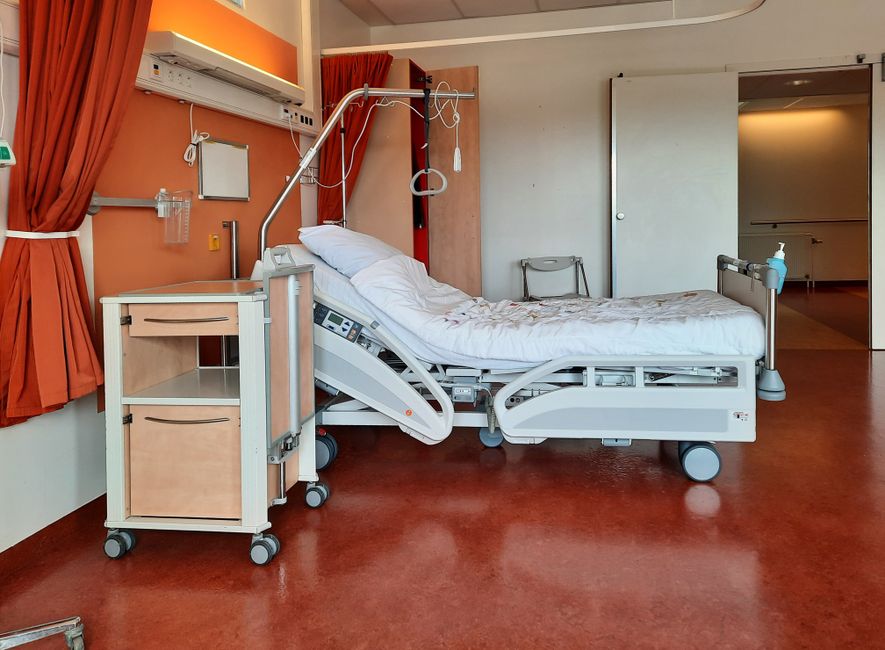
The hidden operational deficits from repeated replacement are a direct drag on medical grade furniture procurement ROI. Each replacement cycle involves shutting down patient rooms, moving patients, hiring installers, and managing waste. A 24-hour shutdown of a 10-bed unit can cost $15,000–$30,000 in lost revenue and staff time, depending on bed occupancy and acuity. Over five replacement cycles, that adds $75,000–$150,000 in soft costs that never appear on the furniture invoice.

What Hospital Furniture Durability Standards Actually Prove
There is no single universal “ANSI/BIFMA medical furniture certificate.” Instead, buyers must identify the standard that matches each product category. ANSI/BIFMA X5.4-2020 (R2025) applies to public and lounge seating used in waiting areas, reception, and patient-room visitor zones. ANSI/BIFMA X5.1 covers general-purpose office chairs used at nursing stations and administrative desks. Compliance should be supported by a model-specific third-party test report from an ISO/IEC 17025 accredited laboratory, not a logo on a brochure.

| Standard | Scope | Correct Procurement Language |
|---|---|---|
| ANSI/BIFMA X5.4-2020 (R2025) | Public and lounge seating (waiting, reception, visitor chairs) | “Tested to ANSI/BIFMA X5.4 with third-party report” |
| ANSI/BIFMA X5.1 | General-purpose office chairs | “Compliant with ANSI/BIFMA X5.1 for task seating” |
| ANSI/BIFMA X5.5 | Desk and table products | “Tested to ANSI/BIFMA X5.5 for work surfaces” |
| ANSI/BIFMA e3 / LEVEL | Sustainability certification | “LEVEL certified for environmental, health, and social impact” |
Beyond mechanical testing, hospital furniture must withstand the facility’s approved disinfectant protocols. CDC guidance requires frequent cleaning of high-touch surfaces with EPA-registered hospital disinfectants and emphasizes following both the disinfectant label and equipment manufacturer’s instructions. A surface that passes a load test but cracks under the facility’s disinfectant is not a durable clinical asset. The chemical compatibility of edge banding, coatings, and fabrics must be documented. The VA also requires medical-grade textiles to pass abrasion, colorfastness, hydrolysis, and moisture barrier tests. These are the real hospital furniture durability standards that drive lifecycle performance.
10-Year Healthcare Lifecycle Cost Analysis
To evaluate medical grade furniture procurement ROI, we recommend the following total cost of ownership formula over a 10-year analysis period:
10-Year TCO = Initial Purchase + Replacement Purchases + Freight/Taxes/Installation + Planned Maintenance + Unplanned Repairs + Clinical Space Downtime + Disposal – Residual Value
Net present value (NPV) adjusts each year’s cash flow by a discount rate, typically the hospital’s cost of capital. The table below compares two illustrative scenarios with clearly stated assumptions. These are not industry averages. Each hospital must substitute its own warranty, failure, freight, and downtime data.
| Scenario | Assumption: Commercial-grade replacement frequency | Commercial Total Purchase (10yr) | Medical-grade Total Purchase (10yr) | Nominal Savings % | Commercial PV (5%) | Medical-grade PV (5%) |
|---|---|---|---|---|---|---|
| Aggressive | Every 2 years, full replacement | $500,000 | $160,000 | 68.0% | $415,279 | $160,000 |
| Conservative | Every 4 years, full replacement | $300,000 | $160,000 | 46.7% | $249,954 | $160,000 |
| Break-even | If commercial-grade lasts 10 years with 1 purchase | $100,000 | $160,000 | -60.0% | $100,000 | $160,000 |
In the aggressive scenario, the $160,000 medical-grade package generates a nominal 68% reduction in purchase expenditure compared to $500,000 for commercial-grade. If we add $80,000 in maintenance and downtime costs (plausible over 10 years for five replacement cycles), the total TCO savings reach 72.4%. However, that $80,000 must be supported by project-specific data. The break-even row shows that if the commercial package lasts the full 10 years without replacement, the medical-grade option is 60% more expensive on purchase alone. This underscores that healthcare lifecycle cost analysis must be based on expected life, not wishful thinking.
Break-Even Question Every CFO Should Ask
Ignoring maintenance and downtime, if a medical-grade package costs 1.6 times the commercial alternative, the commercial option becomes more expensive as soon as it needs a second purchase within 10 years. If the commercial package has an effective life of 6.25 years, a second purchase is likely, pushing total purchase cost above the medical-grade price. But if partial replacement, residual value, or refurbishment is possible, the analysis shifts. A downloadable input spreadsheet with unit price, quantity, expected life, annual repair rate, freight, taxes, installation, downtime hours per event, and discount rate would allow each hospital to run its own numbers.
Reducing Hospital CapEx Without Buying Less
The objective is not to buy the most expensive furniture. It is to buy the lowest-risk asset that meets clinical, mechanical, and cleaning requirements at the lowest verified life-cycle cost. Value engineering can reduce upfront expenditure without compromising durability: standardizing models across departments reduces spare parts inventory and simplifies training; modular casework allows reconfiguration without full replacement; unified finishes and hardware enable swaps from stock; and container-optimized packing cuts freight cost by 15–20%. Pilot installations of sample rooms verify fit and function before bulk purchase. These tactics directly support reducing hospital CapEx budget while maintaining asset quality.
At our own projects, we have seen that a well-defined specification with third-party test reports, chemical compatibility statements, and a clear warranty scope eliminates the need for over-specification. The medical grade furniture procurement ROI analysis should be centered on the specific use case—patient room, nurse station, waiting area—rather than a blanket upgrade. A bed frame in a high-acuity unit has different durability requirements than a chair in a low-traffic administrative office. Applying medical-grade criteria only where justified avoids unnecessary cost inflation.
From Quote Comparison to Asset Governance
Procurement teams should move beyond comparing three quotes and toward an asset governance framework. This includes factory audits, sample room validation, model-specific ANSI/BIFMA test reports, disinfectant compatibility documentation, and a 10-year TCO worksheet with auditable assumptions. Every product delivered should match the tested model, and the warranty exclusions should be transparent about cleaning chemical compatibility and wear limits. Investing in true medical grade furniture solutions is one of the most effective ways to reduce hidden operational deficits and improve long-term asset stability. The difference between price shopping and hospital asset governance is the difference between a purchase order and a balance sheet strategy.
ZHOBAI Medical Furniture
Ready to Apply These Principles to Your Project?
Our engineering team responds to all project briefs within 24 hours. Share your FF&E scope — room count, property type, target timeline, and budget range — and we’ll provide a factory-direct assessment and indicative pricing within one business day.